
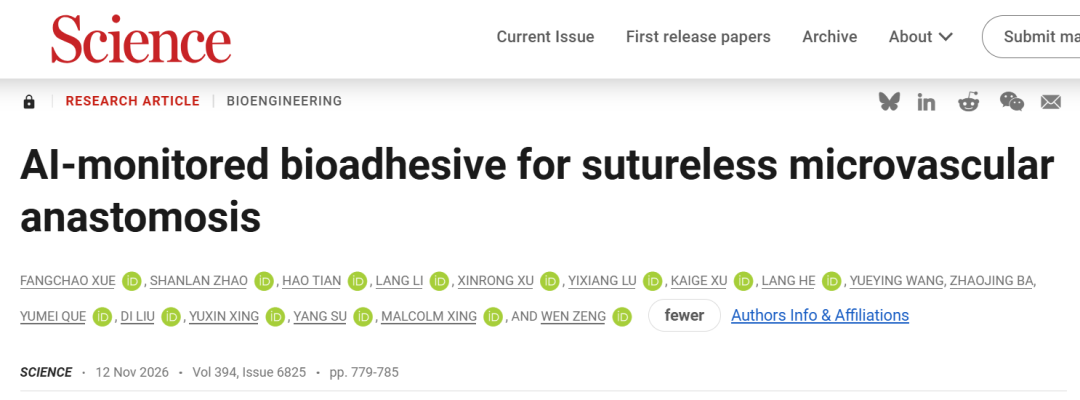
Blood vessels are the channels of life. Since Carrel, the father of vascular surgery, pioneered vascular anastomosis in 1902, microsurgical manual suturing has been the mainstream method of vascular anastomosis. Today, more than a hundred years later, vascular anastomosis has ushered in a new paradigm of rapid adhesion that does not rely on sutures.
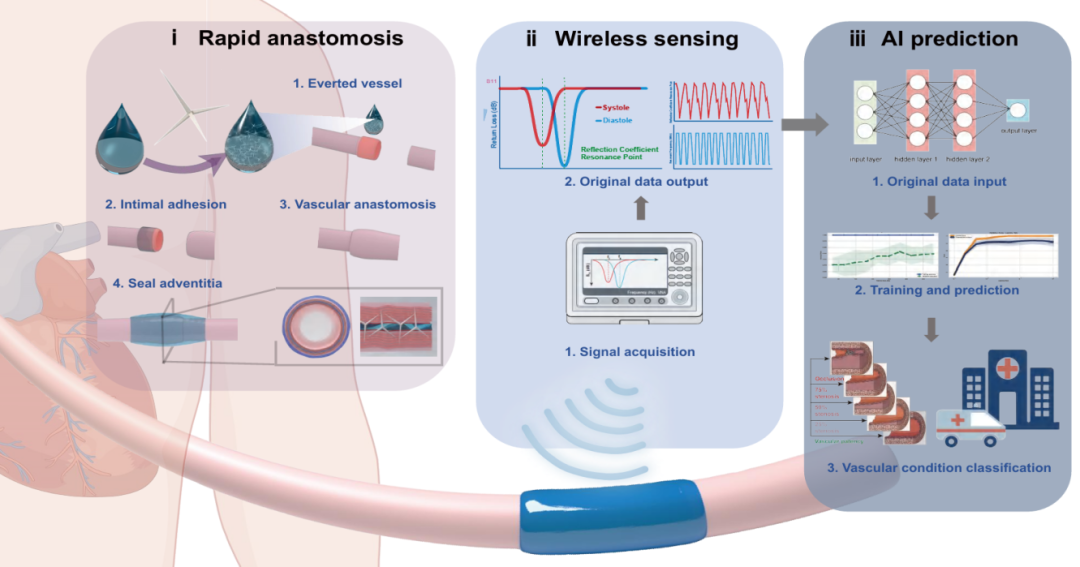
▲ iMAS design principle, vascular anastomosis process and wireless monitoring process
1. Technological innovation: Inspired by plant roots, the iMAS microneedle interlocking adhesive system was developed to achieve fast and stable sutureless microvascular anastomosis.
The research team drew inspiration from the natural phenomenon of plant roots penetrating into the soil and extending firmly in multiple directions to build the iMAS integrated system. The system consists of two core parts: a hydrophobic adhesive matrix and 3D printed four-arm microneedles. Hydrophobic adhesive matrix can drain away water from the blood vessel surface to achieve efficient adhesion ; 3D printed microneedles imitate the mechanism of plant roots penetrating into wet soil, forming a three-dimensional mechanical interlock with the blood vessel wall, completing rapid, sealed, and firm blood vessel docking in a humid, continuously pulsating blood vessel physiological environment.
2. Core breakthrough: Passive wireless sensing combined with AI deep learning enables surgical anastomosis to long-term postoperative intelligent monitoring.
After tissue and organ transplantation, visual and continuous tracking and monitoring of in-body functions is a major difficulty in the current surgical field. This research innovatively integrates passive wireless resonant sensors and AI deep learning algorithms into the iMAS system. Relying on the resonance signal changes caused by blood vessel pulsation, non-invasive and continuous hemodynamic monitoring is completed. By identifying differences in signal amplitude, waveform, and rhythm, it is possible to distinguish and predict whether the transplanted organ maintains normal function or is heading for functional failure, expanding vascular anastomosis from a single surgical operation to a continuous intelligent monitoring method covering the postoperative period.
3. Transformation Prospects : Solving multiple clinical pain points, taking into account the broad application space of routine surgical clinical and emergency treatment
The iMAS integrated system effectively reduces the dependence of microvascular reconstruction on the surgeon's superb micromanipulation ability, greatly shortens the operation time of microvascular anastomosis, reduces endothelial damage and pinhole bleeding caused by suturing, and is expected to improve the surgical efficiency and accessibility of complex reconstructive surgeries. The system's built-in passive wireless sensing and AI analysis module breaks through the limitations of existing imaging that can only perform intermittent examinations, and enables long-term in-body continuous monitoring of anastomotic blood vessels and transplanted organs. It provides early warning for anastomotic stenosis and graft dysfunction, assists clinical practice in achieving early detection and early intervention of complications, and improves the long-term survival prognosis of patients after surgery.
This research was funded by the National Natural Science Foundation of China Youth Science Fund (Category A), the National Natural Science Foundation of China Regional Innovation and Development Joint Fund, and the National Key R&D Program. 。
In the next step, Professor Zeng Wen's team will continue to delve into the three major directions of blood vessel and tissue and organ regeneration, cell robotics, and AI precision treatment, focusing on microvascular reconstruction, organ repair, and biomaterials. Relying on the "basic research-cutting-edge research-clinical transformation" closed-loop system built by Jinfeng Laboratory, we will attract young talents, promote cross-innovation of AI, biomaterials, and regenerative medicine, produce original results, and help create an innovation hub for tissue regeneration and intelligent medicine.
《 Science" ("Science") is sponsored by the American Association for the Advancement of Science (AAAS) and was founded in 1880. It is the world's top comprehensive academic weekly and is one of the three top journals of CNS together with "Nature" and "Cell". The journal covers all disciplines such as life sciences, materials, engineering, and medicine, and publishes high-level original results, cutting-edge reviews, and scientific news that have been rigorously peer-reviewed. It is known for publishing major breakthrough research and has strict review standards. It is one of the core benchmark journals that measures the original strength of basic and translational scientific research. 。
Click below to read the original text and access the original text link.
https://www.science.org/doi/10.1126/science.aed8712


Number
023-68059937
Email:Jinfeng@jflab.ac.cn
Address:
No.313, Bella Road Chongqing High-tech Zone
Postal code: 401329

 渝公网安备50009802002274