
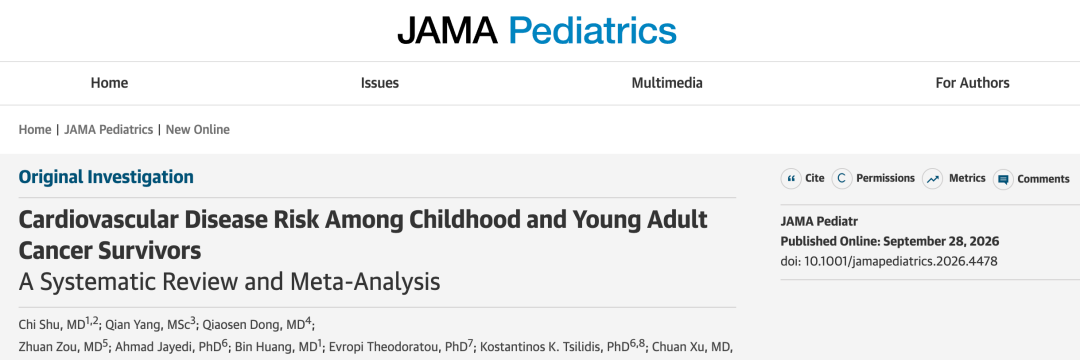
With advances in cancer treatment, the 5-year survival rate of CAYA cancer survivors has exceeded 80%. However, during long-term survival, cardiovascular disease has become one of the most important non-cancer long-term comorbidities and causes of death in CAYA cancer survivors. Previous studies have suggested that part of this cardiovascular risk comes from cardiovascular toxicity associated with treatments such as chemotherapy and radiotherapy, but more and more basic research evidence shows that the systemic effects of cancer itself may also accelerate cardiovascular dysfunction.
In recent years, Professor Xu Chuan’s team has carried out a series of research work in the field of oncology and cardiology. For adult cancer survivors, the team previously published a study in BMJ Public Health, based on a large-sample prospective cohort of the UK Biobank and a meta-analysis of 104 previously published cohort studies, and found that the risk of cardiovascular events in adult cancer survivors was significantly increased by 34%. Even without chemotherapy or radiotherapy, the cardiovascular risk is still increased by about 22%, suggesting that there may be shared pathogenic mechanisms between cancer and cardiovascular disease. Subsequently, the team reported the results of a study based on 47 population-based cohorts in the journal BMC Medicine, and found that patients with cardiovascular disease had a significantly increased subsequent overall cancer risk of about 13%, adding evidence that cancer and cardiovascular disease "go both ways" from the perspective of "reverse cardio-oncology."
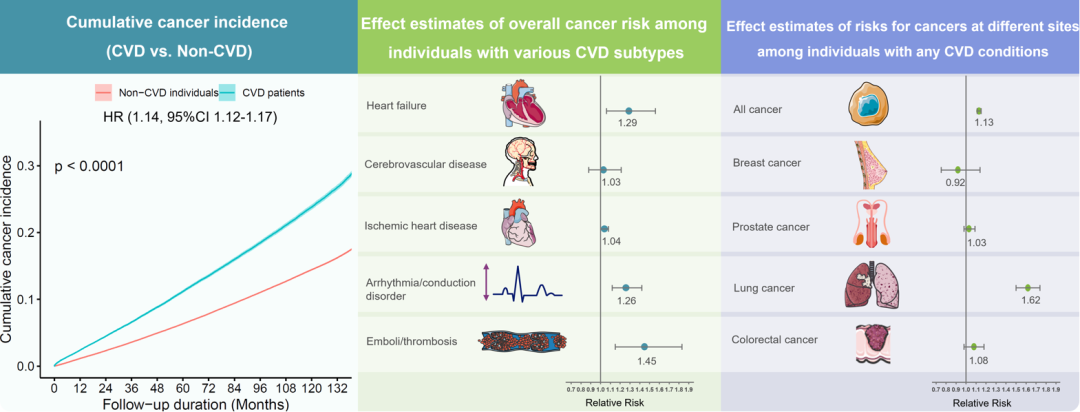
▲Bidirectional association between cardiovascular disease and major cancer types
As for the special group of childhood and adolescent cancer survivors (CAYA), they are still in the growth and development stage when they suffer from cancer. During the longer life span after the tumor is cured, the health damage caused by anti-tumor treatment and the tumor itself will continue to appear decades later. This is completely different from the long-term disease risk characteristics of middle-aged and elderly tumor survivors, and has not been fully studied in the past. In this study, the team focused on CAYA cancer survivors and systematically evaluated their long-term cardiovascular risks in different age groups. The research team searched Medline, Embase, and Cochrane Library databases to compare CAYA cancer survivors with cancer-free CAYA controls, and finally included 39 cohort studies. ; Twenty-one of the cohorts focused on childhood cancer survivors, and 11 studied young adults, with a median follow-up time of 13.4 years. The study used a random effects model to combine effect sizes, and conducted subgroup analysis and sensitivity analysis.
Compared with their cancer-free CAYA peers, CAYA cancer survivors had a significantly increased overall CVD risk (RR=1.99, 95% CI 1.66-2.40), equivalent to approximately 90 additional CVD events per 1,000 survivors. Stratified by age, childhood cancer survivors had higher CVD risk than young adult survivors (childhood: RR=2.48, 95%CI 1.87-3.27 ; Young adults: RR=1.61, 95%CI 1.37-1.88). Stratified by follow-up time, the risk showed a downward trend with longer follow-up but always remained significant. The risk of CVD was highest within 10 years of follow-up (RR=2.39, 95%CI 2.10-2.71), and remained significantly elevated after more than 20 years of follow-up (RR=1.44, 95%CI 1.23-1.69). For each additional year of follow-up, the risk estimate significantly decreased by approximately 3%. From the analysis of different cardiovascular disease subtypes, the increased risk of heart failure is the most prominent (RR=3.71), followed by cerebrovascular disease (RR=2.70), venous thromboembolism (RR=2.24), ischemic heart disease (RR=1.53) and arrhythmia (RR=1.53). By cancer type, survivors of Hodgkin's lymphoma, leukemia, central nervous system tumors, neuroblastoma, kidney cancer and bone cancer were at higher risk.
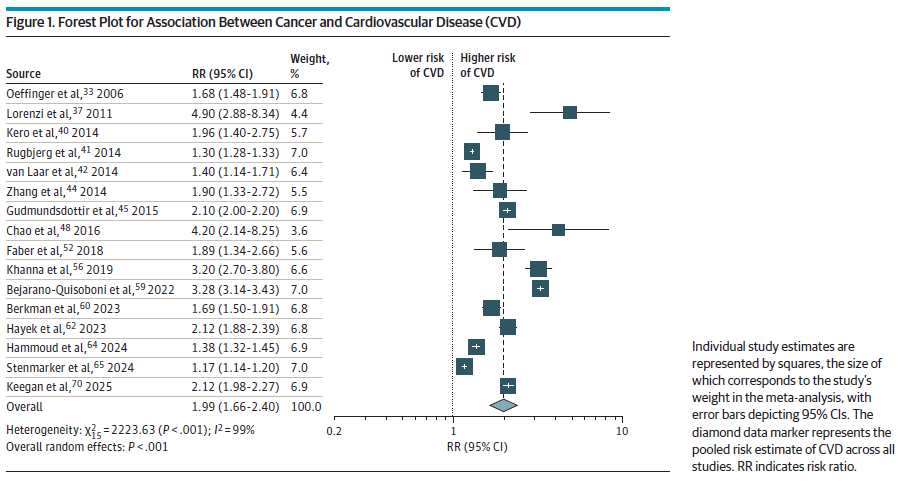
▲ CAYA Survivor cardiovascular risk estimates Forest plot of main research results
This study shows that CAYA cancer survivors, especially those diagnosed in childhood, face significantly elevated long-term cardiovascular risks. The risk is highest early after diagnosis, but this elevated risk can persist for more than 20 years. In terms of pathogenesis, in addition to treatment-related cardiotoxicity, processes such as cancer-related inflammation, immune dysregulation, oxidative stress, endothelial dysfunction, metabolic disorders, and accelerated aging may all be involved in the occurrence of cardiovascular events. In clinical work, oncology and cardiology departments should strengthen collaboration, conduct precise risk stratification assessment of CAYA survivors starting from cancer diagnosis, and establish a lifelong cardiovascular risk monitoring strategy, with particular attention to young childhood survivors.
JAMA Pediatrics, sponsored by the American Medical Association (AMA, JAMA Network), publishes original research, reviews and reviews of important clinical value and scientific significance in the field of pediatrics and adolescent health, providing cutting-edge academic reference and clinical evidence-based basis for pediatricians, child health researchers and related clinical researchers. The impact factor in 2024 is 24.7 (ranked first in the field of pediatrics), JCR division Q1.
Click below to read the original text and access the original text link.
https://doi: 10.1001/jamapediatrics.2026.4478.

Number
023-68059937
Email:Jinfeng@jflab.ac.cn
Address:
No.313, Bella Road Chongqing High-tech Zone
Postal code: 401329

 渝公网安备50009802002274