
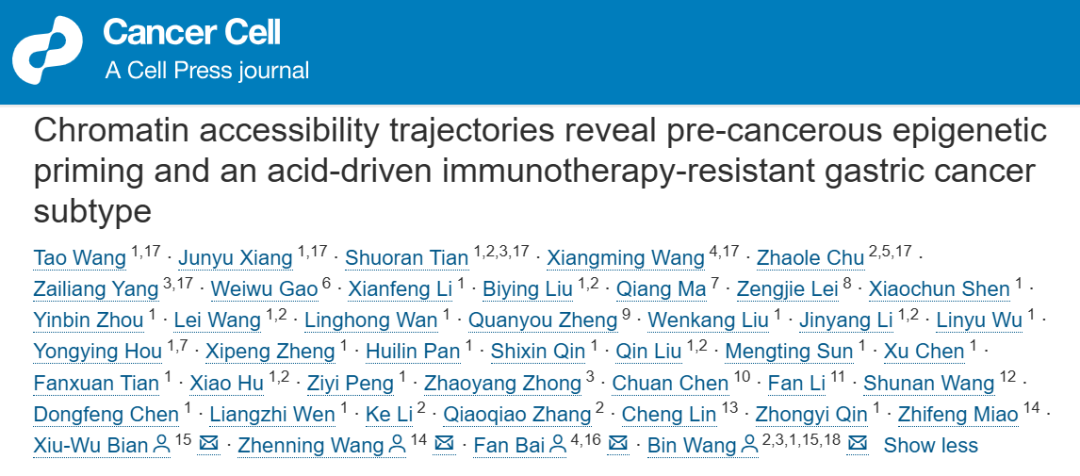
October 6, Professor Bian Xiuwu, Southwest Hospital/Jinfeng Laboratory, Army Medical University , Professor Wang Bin's team, together with Professor Bai Fan from Peking University's Biomedical Frontier Innovation Center, and Professor Wang Zhenning's team from China Medical University, published a research paper titled "Chromatin accessibility trajectories reveal precancerous epigenetic priming and an acid-driven immunotherapy-resistant gastric cancer subtype" online in the top international oncology journal "Cancer Cell". The study included a total of 650 gastric mucosal tissue specimens from 439 patients, which completely covered gastric cancer and precancerous lesions at various stages. It systematically drew the largest panoramic map of chromatin accessibility in the development of human gastric cancer to date, analyzed the apparent evolution trajectory of gastric mucosal canceration, proposed a new concept of "apparent preparation for precancerous lesions", established the "Golden Phoenix Classification of Gastric Cancer" to guide precise immunotherapy, revealed the core regulatory hub of immune-resistant subtypes, and developed new strategies for clinical intervention.
▲Core discovery one: Analyzing the epigenetic evolution rules of gastric cancer occurrence and development, and proposing a new perspective on "epigenetic preparation of precancerous lesions"
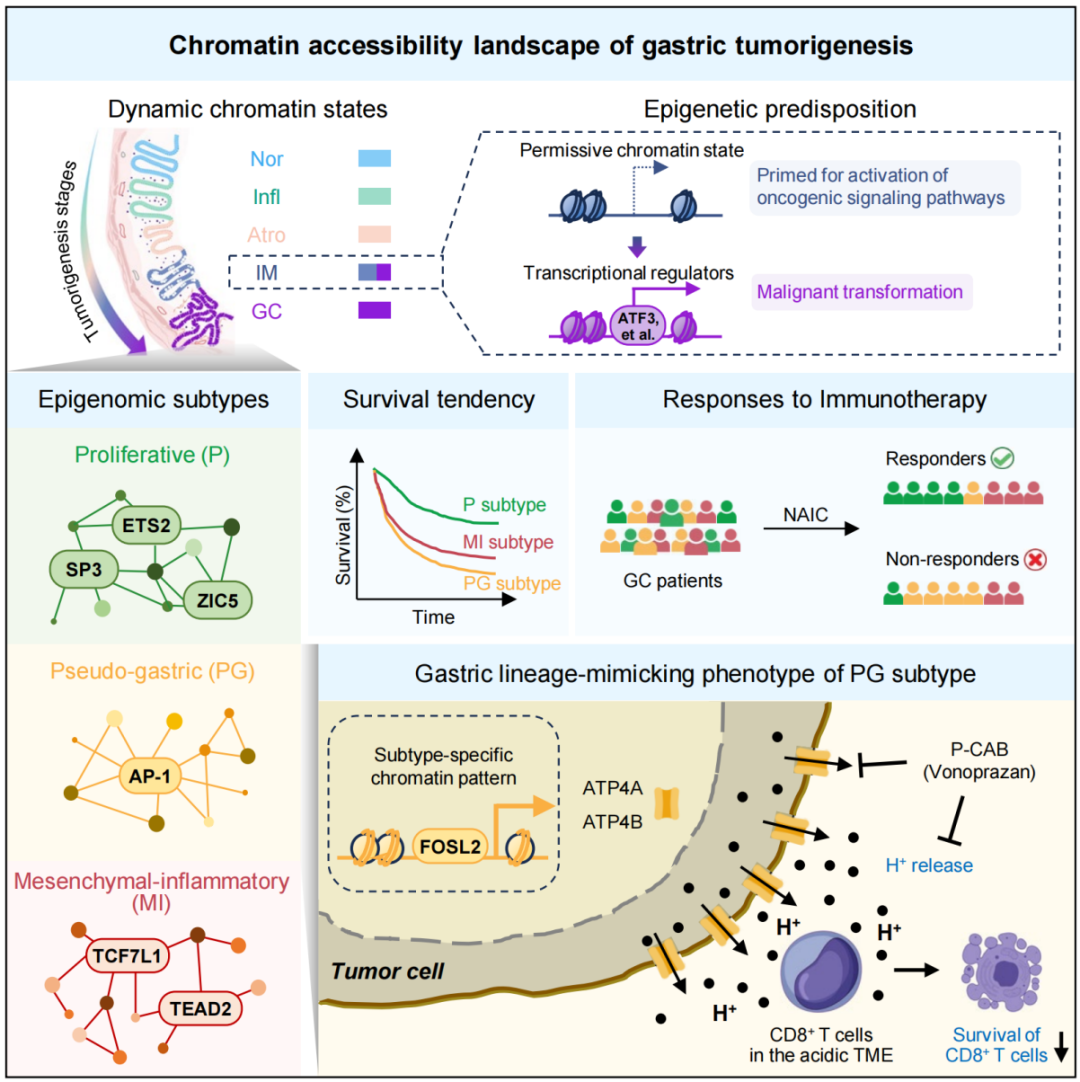
The research team found that chromatin remodeling exists throughout the occurrence of intestinal-type gastric cancer and has an epigenetic evolution trajectory throughout the entire process of carcinogenesis. Intestinal metaplasia already has chromatin accessibility characteristics that are highly similar to those of intestinal-type gastric cancer. Unsupervised clustering of accessibility elements that dynamically change during tumorigenesis resulted in a total of 10 dynamic peak clusters. Among them, the C9 peak cluster, which accounts for nearly half of the intestinal metaplasia stage, also remains open in tumors, which is an important reason for the similarity in apparent characteristics between intestinal metaplasia and tumors.
Integrating single-cell and multi-omics data found that 47% of the C9 peak cluster regions in intestinal metaplasia tissue are in an "apparent pre-activation state": these chromatin regions that regulate multiple tumor initiation-related signaling pathways such as Hippo, ERK, Notch, and Wnt are fully open during the intestinal metaplasia stage, but the transcription of their downstream oncogenic pathway genes is only driven and activated by ATF3 and other transcription factors during the gastric cancer stage, showing a significant transcriptional lag effect. In a mouse model of spontaneous gastric cancer, interfering with ATF3 significantly prevented tumor development ; Clinical sample testing also shows that incomplete intestinal metaplasia (higher risk of canceration) has a stronger "apparent pre-activation state" than complete intestinal metaplasia, suggesting that this state is closely related to gastric cancer susceptibility.
▲ Core Discovery 2: Creating a gastric cancer epigenome classification, the “Golden Phoenix Classification of Gastric Cancer”, to efficiently predict the efficacy of neoadjuvant immunotherapy
Based on the chromatin accessibility data of 439 cases of advanced gastric cancer tissues, the research team used two clustering methods to divide advanced gastric cancer into three stable epigenomic subtypes: proliferative subtype (P), gastric pseudosubtype (PG), and interstitial inflammation subtype (MI). In terms of clinical prognosis, the results of the internal cohort and external cohorts such as TCGA and ACRG are consistent: P subtype patients have the best prognosis, and patients with PG and MI subtypes have shorter survival times. Although this epiphenotype partially overlaps with the existing molecular subtype of gastric cancer, the PG subtype has not been recognized by previous molecular subtypes. Therefore, it is found that the PG subtype is a unique gastric cancer subtype driven by appearance.
In terms of clinical immunotherapy, data from the phase II clinical trial of neoadjuvant immunotherapy for gastric cancer conducted by the team showed that more than 70% of the proliferative subtype and 50% of the interstitial inflammatory subtype can achieve major pathological remission, while only about 25% of the gastric mimetic subtype can be achieved. Multiple external validation cohorts of gastric cancer at home and abroad have also confirmed that the PG subtype has primary resistance to immunotherapy. In addition, after excluding immunotherapy-advantaged groups such as MSI-H and EBV+, the predictive value of this epitype remains stable. These data suggest that epigenomic typing is independent of existing immunotherapy markers and can serve as an important supplement to more comprehensively screen potential benefit populations.
▲ Core discovery three: Discover the phenomenon of immune resistance driven by active acid secretion of tumors, and propose a new strategy for vonoraxin-sensitized gastric cancer immunotherapy
For the immune-resistant PG subtype, studies have found that this subtype uses a unique chromatin remodeling state to hijack the gastric lineage gene program, prompting tumor cells to highly express the proton pump ATP4A/ATP4B, and release H⁺ into the microenvironment, causing acidification of the tumor microenvironment, damaging the survival and effector functions of CD8⁺T cells, and leading to resistance to immunotherapy.
In terms of regulatory mechanisms of drug-resistant subtypes, the transcription factor FOSL2 plays a central role in maintaining the gastric lineage phenotype.; Interfering with FOSL2 can reduce the expression level of ATP4A/ATP4B, weaken the acid secretion phenotype, restore the survival and antigen-specific killing ability of CD8⁺T cells, and thereby enhance sensitization immunotherapy. In view of the fact that FOSL2 is widely expressed in normal gastrointestinal mucosa and direct targeting may cause serious side effects, the team further explored sensitization options and found that vonorazan (VPZ), a commonly used clinical potassium ion competitive acid blocker (P-CAB), can effectively inhibit the acid secretion ability of PG subtype tumor cells. Combined immunotherapy can significantly increase the number of intratumoral CD8⁺T cell infiltration and synergistically inhibit the growth of drug-resistant tumors.
Post hoc analysis of clinical trials showed that patients with PG subtype gastric cancer who had a history of taking vonoraphan during neoadjuvant immunotherapy had a major pathological response rate of 55.6%, and CD8⁺T cell infiltration was more abundant in the tumor lesions.; However, the major pathological response rate of patients without a history of vonorazan medication was only 14.3%, which provides preliminary clinical basis for the vonorazan-based immunotherapy sensitization strategy.
Theoretical value and clinical translation prospects
This study is the first to draw a large-scale chromatin accessibility map covering multiple pathological stages of human gastric cancer development, proposes a new perspective on "epigenetic preparation of precancerous lesions" driving tumorigenesis, and updates the epigenetic regulation theory of gastric cancer.; Establishing the "Golden Phoenix Classification of Gastric Cancer" system to provide a new basis for accurately screening people who will benefit from immunotherapy ; Based on the acid-driven immune resistance mechanism and vonorazan sensitization strategy, it provides a new clinical exploration solution for reversing immunotherapy resistance. Overall, this research provides a new theoretical support and transformation path for the mechanism of gastric cancer and precision immunotherapy.
"Cancer Cell" is a top international journal in the field of oncology, published by Cell Press and founded in 2002. The journal is committed to publishing major original results in the fields of basic cancer research and clinical oncology, covering multiple cutting-edge directions such as tumorigenesis mechanisms, immunotherapy, precision medicine, and translational research. The impact factor is 56.1, and it is a top journal in Area 1 of the Chinese Academy of Sciences. 。
Click below to read the original text and access the original text link.
https://www.cell.com/cancer-cell/abstract/S1535-6108(26)00401-0

Number
023-68059937
Email:Jinfeng@jflab.ac.cn
Address:
No.313, Bella Road Chongqing High-tech Zone
Postal code: 401329

 渝公网安备50009802002274