
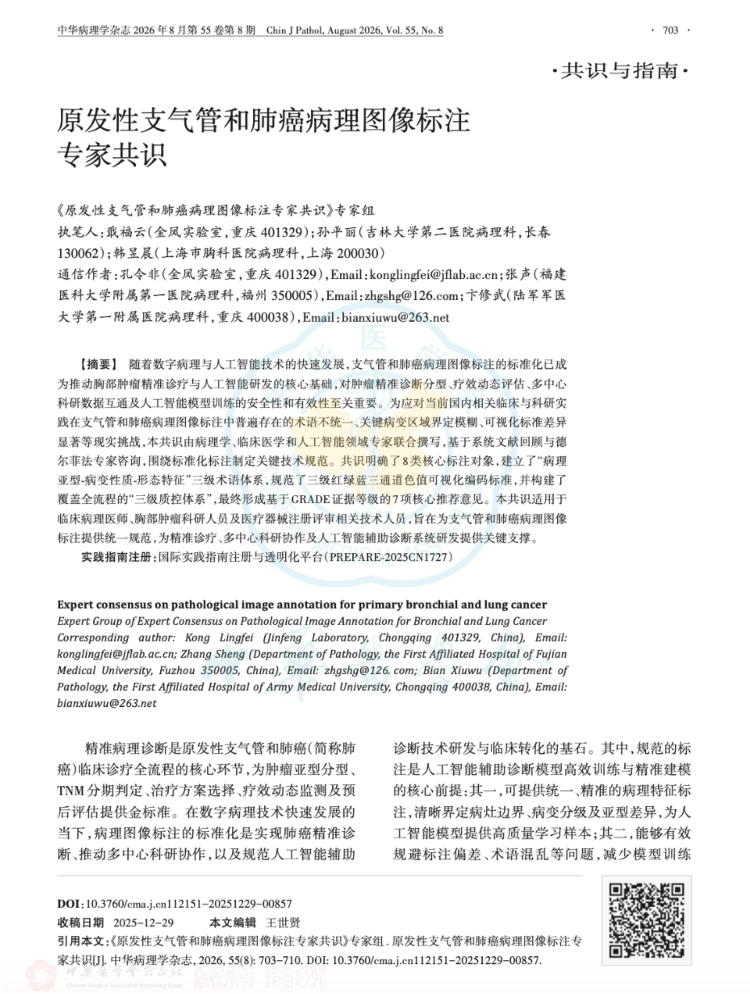
This consensus brings together the top forces in the field of pathology in China. It was compiled by more than 40 interdisciplinary experts including Academician Bian Xiuwu from the First Affiliated Hospital of Army Medical University, Jinfeng Laboratory, Professor Kong Lingfei from Jinfeng Laboratory, and Professor Zhang Sheng from the First Affiliated Hospital of Fujian Medical University, which took nearly a year to complete.
Currently, the incidence of lung cancer in my country remains high, and the talent gap for professional pathologists continues to expand. AI-assisted pathological diagnosis has become a core path to fill the shortcomings of medical resources and improve grassroots diagnosis and treatment capabilities. Standardized, traceable, and highly consistent pathology annotation data is a prerequisite for the safe implementation and compliant application of AI pathology technology. It is also the core foundation for achieving accurate tumor classification, dynamic evaluation of therapeutic efficacy, multi-center collaborative scientific research, and the transformation of AI medical device compliance registration.
For a long time, there have been obvious shortcomings in the domestic lung cancer pathology annotation industry, which have seriously restricted the development of the smart pathology industry: industry terminology standards are not unified, medical institutions at all levels have their own system of annotation specifications, insufficient connection with internationally accepted classification standards, and lesion annotation descriptions are confusing.; Key pathological structures such as tumor infiltration boundaries, vascular tumor thrombus, and micro-metastasis lack quantitative judgment rulers. The annotation results are highly dependent on the subjective experience of physicians and have poor reproducibility. ; At the same time, the industry lacks unified visual coding, universal annotation tools and full-process quality control rules. Various pathology data form information islands, which directly results in large training deviations in lung cancer AI model training and weak cross-hospital generalization capabilities, significantly raising the threshold for R&D and registration approval of AI pathology equipment.
💡 Breakthrough in industry pain points|Building a full-process closed-loop standard system
In response to the above-mentioned industry pain points, this consensus innovation collaboration establish “Digital slice collection—standardized terminology annotation—visual color coding—three-level quality control throughout the process” The closed-loop standard system has introduced a number of domestic first-of-its-kind technical specifications to comprehensively fill in the shortcomings of industry standardization.
At the level of terminology specification
The consensus strictly benchmarks the 2021 version of the WHO International Classification of Lung Tumors, delineates eight categories of core labeling objects, and constructs a three-level terminology framework of "pathological subtypes-lesion properties-morphological characteristics" to refine the distinction between lung cancer and various subdivided lesion structures, eliminate vague and non-standard descriptions, solve the industry chaos of "different labels for the same disease," and achieve unified labeling terminology across the country.
Visual coding aspects
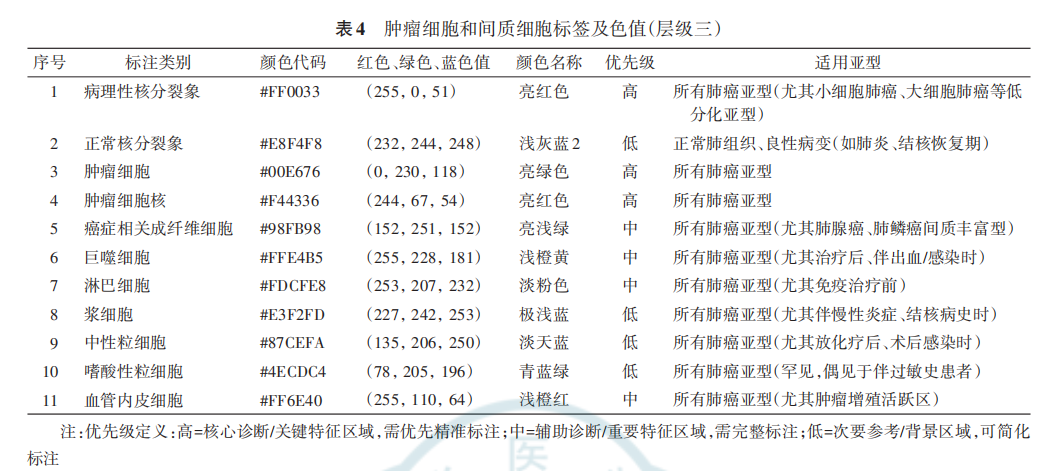
For the first time in China, the three-level RGB fixed color value specification is innovatively launched to match exclusive color numbers for hundreds of types of structures such as the main tumor area, microscopic pathological characteristics, and interstitial immune cells. It follows the clinical visual logic of "eye-catching high-risk lesions and soft differentiation of background tissues." After unifying the color standard, cross-organization and cross-system annotated images can be directly compared and compared, completely breaking through the barriers to multi-center data visualization sharing.
Labeling accuracy level
Consensus innovatively establishes pixel-level quantitative judgment standards, sets grading error thresholds for different magnification fields of view, and replaces traditional subjective judgments with digital quantitative indicators.; At the same time, the hard indicators of consistency are clearly marked: the overall labeling Kappa ≥ 0.85, and the tumor core feature Kappa ≥ 0.90, which significantly improves the labeling accuracy and reproducibility.
quality control level
Innovatively designed a three-level full-process quality control mechanism of "annotator self-examination - deputy senior professional title expert group cross-review - MDT multi-disciplinary expert group double-blind final review", covering the entire chain of pre-job training, process sampling inspection, and quarterly full-dimensional evaluation; It is clear that the compliance rate of core quality control indicators is not less than 95%. For difficult lesions, tiny lesions, and complex lesions after treatment, the consensus requires the implementation of mandatory independent annotation by two people to achieve 100% traceability of metadata throughout the process, fully meeting the data compliance requirements for multi-center clinical scientific research and AI medical device registration.
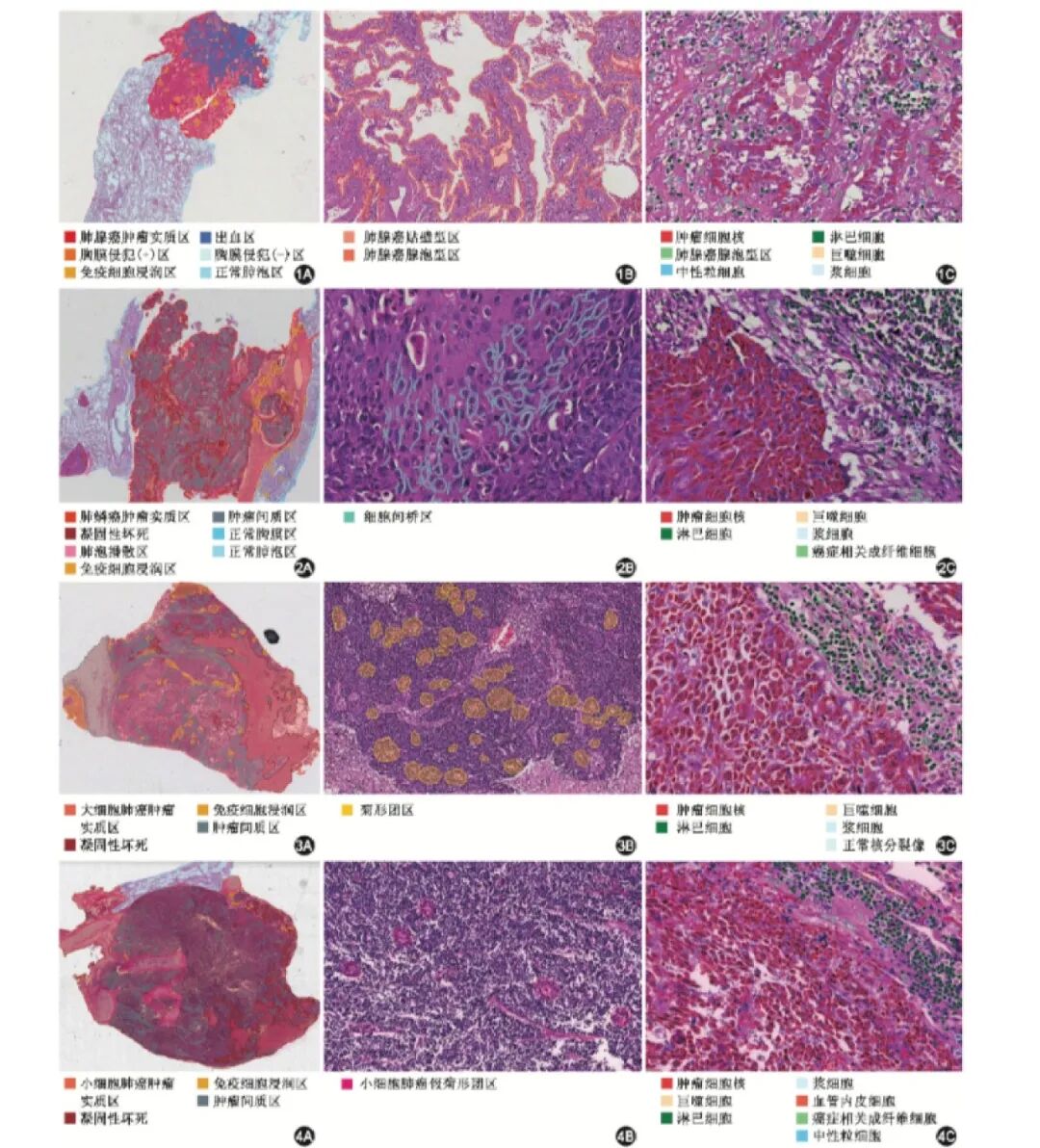
▲ Examples of pathological image annotation of major subtypes of lung cancer; A, B, C, and D are schematic diagrams of pathological image annotation of lung adenocarcinoma, squamous cell carcinoma, large cell carcinoma, and small cell carcinoma respectively.
📌Four dimensions of value|Empowering clinical, scientific research, industry, and platform development
The release of this consensus releases important value in multiple dimensions such as clinical, scientific research, industry and platform construction.
Pro bed end : Unified labeling standards can narrow the pathological diagnosis gap between primary medical institutions and tertiary hospitals, support the implementation of remote pathology consultation, promote the sinking of high-quality medical resources, and provide objective diagnostic basis for personalized and precise treatment of lung cancer.
Scientific research side : Unify annotation standards to solve the problem of multi-center data fragmentation, achieve compatible integration and joint modeling of cross-hospital data sets, build a solid standard foundation for the national standardized lung cancer pathology image database, and accelerate the implementation of cutting-edge translational medical research.
Industrial side : Standardized high-quality annotated data can optimize the AI model training effect, improve the accuracy and cross-scenario adaptability of the auxiliary diagnosis system, provide a unified basis for AI medical device registration review, reduce corporate R&D and application costs, and promote the standardized and high-quality development of the domestic digital pathology industry.
Platform side : Taking the lead in releasing the first authoritative consensus on pathological annotation of lung cancer in China, it is a key milestone for Jinfeng Laboratory to open up the entire innovation chain of "pathology standard formulation-standardized data platform-algorithm development-clinical industry transformation", further consolidating my country's leading position in the field of digital pathology standardization of thoracic tumors.
In the next step, the research team will establish an annual dynamic revision mechanism, continue to carry out multi-center clinical verification, supplement and improve the labeling details of rare tumors and special specimens after treatment, actively connect with relevant international digital pathology standards, and promote international collaboration, joint construction and sharing.
In the future, Jinfeng Laboratory will continue to promote the "Standardized Pathology Database Plan for Tens of Millions of Pan-Diseases" on this basis, rely on its own technology and platform to build a standardized data base, promote smart pathology technology to sink into grassroots and provide inclusive clinical benefits, use standards to drive industry innovation, and continue to contribute to the construction of a high-level innovative city and the implementation of the Healthy China 2030 strategy.


Number
023-68059937
Email:Jinfeng@jflab.ac.cn
Address:
No.313, Bella Road Chongqing High-tech Zone
Postal code: 401329

 渝公网安备50009802002274