
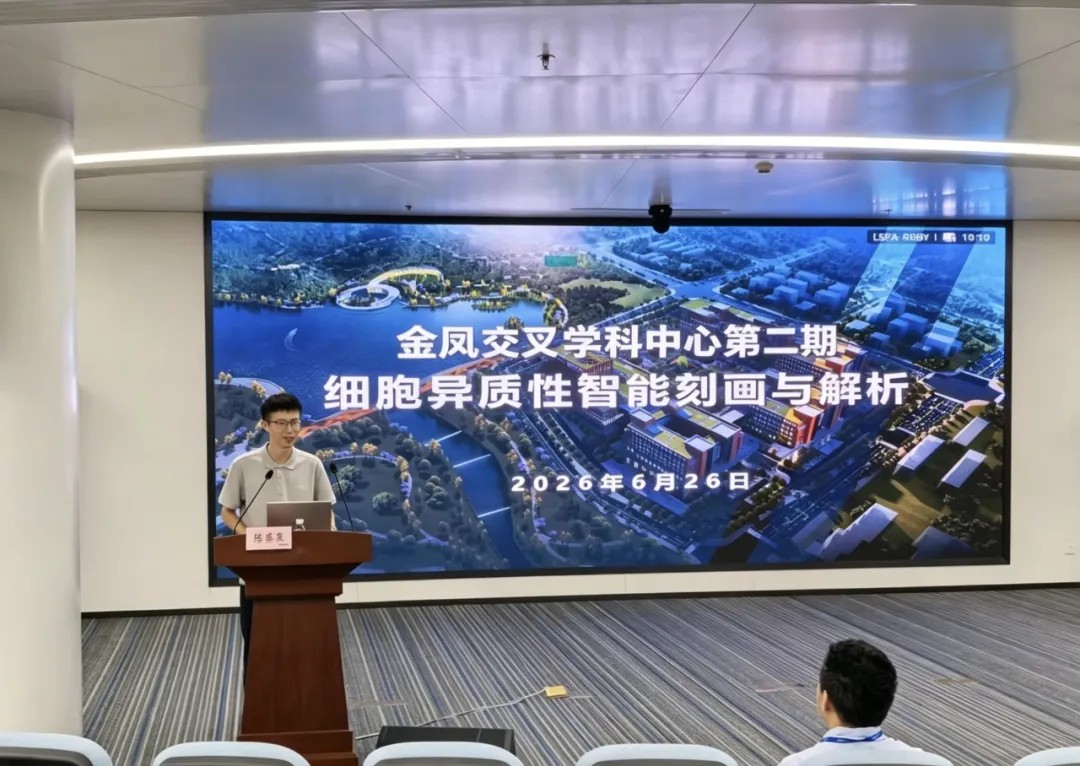
2026 On June 26, the second academic lecture of the Interdisciplinary Center was successfully held. This lecture focuses on the core pain points of single-cell multi-omics data analysis and builds a cross-communication platform for mathematics, computers and biomedicine. Professor Chen Shengquan from the School of Mathematical Sciences of Nankai University was specially invited to give a cutting-edge academic lecture. Attract scientific researchers from various fields such as laboratory mathematics, computers, biotechnology, and medicine to come and study on site. The academic atmosphere on site is warm 。
Introduction to the speaker
Chen Shengquan , professor and doctoral supervisor at the School of Mathematical Sciences of Nankai University, a national high-level young talent, and one of Nankai University’s “100 Young Academic Leaders”. Hosted the National Natural Science Foundation of China youth and general projects, and published more than 30 academic papers as the first or corresponding author (including co-authors). He serves as the secretary-general of the Intelligent Health and Bioinformatics Committee of the Chinese Society of Automation, a standing member of the Bioinformatics and Artificial Life Committee of the Chinese Society of Artificial Intelligence, a director of the Chinese Council of the International Society for Computational Biology, and a youth editorial board member of Science Bulletin, GPB, JGG and other journals. He has been selected as one of Tsinghua University's "Academic Rookies" in 2021, the China Association for Science and Technology's Young Talent Promotion Project in 2023, the National Major Talent Project's Young Scholars in 2024, and the Tianjin U40 Cultivation Project in 2025.
Key points of the lecture
Book This lecture, Professor Chen Shengquan, focused on common problems and technological breakthroughs in the field of single cell epigenomic data analysis. It is pointed out that there are significant shortcomings in current single-cell epigenetic data. Not only do they have data characteristics of millions of ultra-high dimensions, more than 90% of values are missing, and extremely low signal-to-noise ratio, they also face multiple computational bottlenecks such as batch effect interference, difficulty in identifying rare cells, high computational pressure on tens of millions of cells, and false negative bias, which greatly limits the advancement of related research. In response to the above-mentioned industry pain points, Professor Chen Shengquan's team independently developed a three-layer integrated algorithm framework of unsupervised, weakly supervised and supervised to break through technical barriers in all aspects. Among them, the unsupervised system relies on adaptive iterative optimization to complete core processing such as data noise reduction and batch effect correction. The innovative mapping scheme takes into account bias elimination and preservation of real biological differences, significantly reducing the cost of map reconstruction. The weakly supervised model integrates single cell and spatial reference data, uses the Bayesian graph model to mine spatial correlations between cells, and revitalizes public data resources. The supervised framework relies on contrastive learning and graph networks to achieve intelligent annotation of cells and identify new subtypes. It also reveals for the first time security risks such as backdoor attacks and data poisoning in large single-cell models, providing a new basis for data quality control. The interactive session of the lecture was lively and the participants had in-depth exchanges on practical difficulties such as cross-omics integration, very large data set operations, cross-species data fusion, and model optimization. Finally, Professor Chen Shengquan pointed out that at present, the relevant algorithms have only completed theoretical verification. In the future, cross-border collaboration with biological laboratories will be deepened to customize optimization models for core areas such as tumors, nerves, and embryonic development, promote algorithm implementation and wet experimental verification, and truly realize data-driven innovative research in life sciences.
Book This lecture broke through the disciplinary barriers between computational algorithms and basic medicine, effectively broadened the interdisciplinary scientific research horizons of teachers and students, and established a good communication platform for subsequent industry-university-research collaboration and joint research on topics. Participants reported that this lecture has both theoretical depth and practical value, provides a new research method for single cell omics data analysis, and helps solve core life science problems such as cell development and disease mechanisms by relying on intelligent computing.


Number
023-68059937
Email:Jinfeng@jflab.ac.cn
Address:
No.313, Bella Road Chongqing High-tech Zone
Postal code: 401329

 渝公网安备50009802002274