
Technological innovation: Design a new CAR-M2 immune cell therapy strategy with both targeted phagocytosis and vascular reconstruction capabilities, and create a HAMA-CS hydrogel subrenal capsule in-situ precise delivery platform.
Inspired by tumor immunotherapy, the team introduced chimeric antigen receptor technology into the treatment of renal fibrosis, and designed a bifunctional CAR-M2 vector to meet the synergistic needs of anti-fibrosis and pro-angiogenesis in the fibrosis niche: including anti-FAP single-chain variable region (scFv), CD8 hinge and transmembrane region, CD137 costimulatory domain, CD3ζ phagocytic signaling domain and IL-4 secretion sequence. This design has threefold advantages: anti-FAP scFv precisely targets and phagocytizes fibrosis-specific activated FAP⁺fibroblasts ; CD3ζ enhances phagocytosis efficiency ; IL-4 maintains the M2 phenotype and directly participates in renal microvascular remodeling. In vitro experiments have confirmed that CAR-M2 significantly upregulates M2 markers (CD163, Arg-1, IL-10), and its culture supernatant can promote human umbilical vein endothelial cell tube formation, and its phagocytosis efficiency of FAP⁺ human kidney fibroblasts is more than 2 times higher than that of the control group, laying a solid foundation for in vivo application.
In order to solve the problem of low cell survival rate in vivo and difficulty in targeting solid organs, the team designed a low-swelling, injectable HAMA-CS hydrogel to locally deliver CAR-M2 to the fibrotic kidney through minimally invasive injection under the renal capsule. The hydrogel can sustainably release CAR-M2 in the body for 21 days, significantly improving cell retention and therapeutic effects.
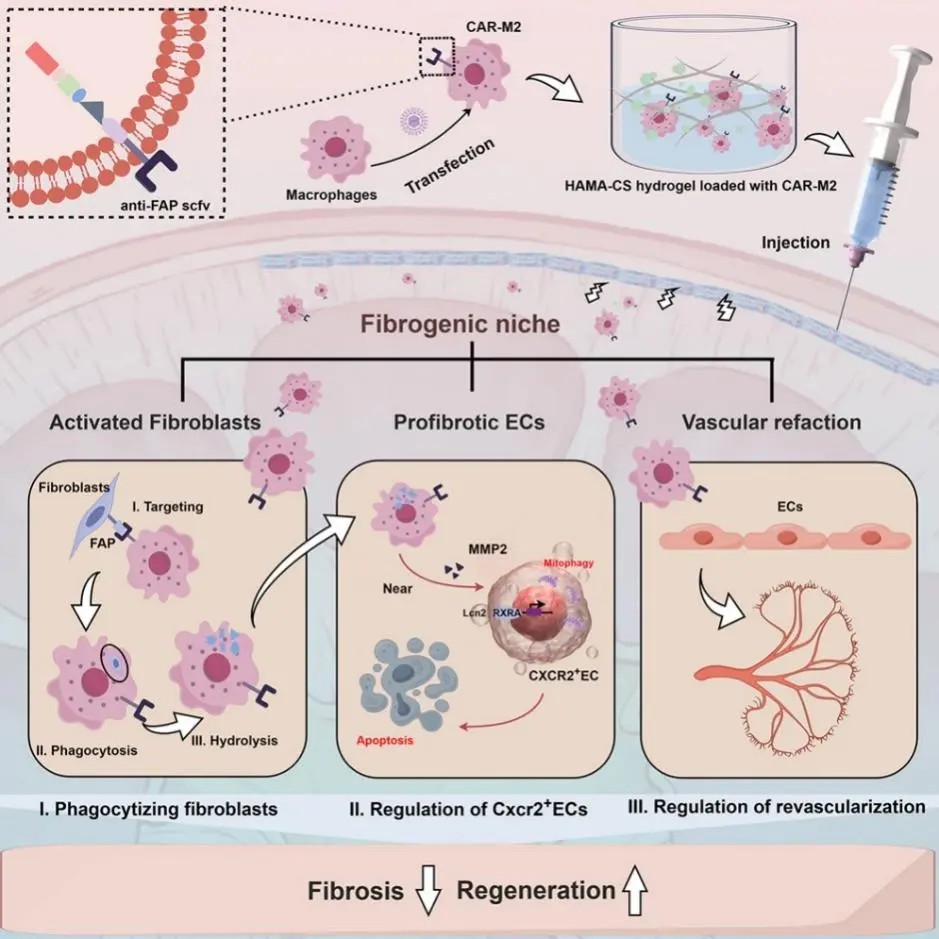
▲ The overall research idea of CAR-M2 targeting to eliminate FAP+ fibroblasts and regulating Cxcr2+ endothelial cells to reverse renal fibrosis (excerpted from Cell Reports Medicine)
Core discovery 1: From a clinical perspective, there is high expression of FAP and sparse microvessels in the renal tissue of CKD patients, and the profibrotic Cxcr2+ endothelial cell subpopulation was identified for the first time.
By analyzing kidney biopsy samples from clinical CKD patients and public single-cell databases, the research team found that the fibroblast activation protein FAP was significantly highly expressed in fibroblasts of fibrotic kidney tissue, while it was almost not expressed in normal kidneys and major organs such as the heart, liver, spleen, and lungs, confirming that FAP is an ideal anti-fibrosis therapeutic target. At the same time, CD31 staining and micro-CT angiography showed that fibrotic kidneys had significant microvascular sparseness, and the density of capillaries in the renal cortex of UUO mice decreased by more than 40% compared with normal. This reduction in blood vessels led to tissue hypoxia and loss of repair ability, causing fibrosis to enter an irreversible stage. Therefore, an ideal anti-fibrotic treatment must not only eliminate disease-causing cells but also reconstruct the vascular network.
In order to analyze the cellular basis of anti-fibrosis treatment, the research team conducted single-cell transcriptome sequencing on the kidneys of two groups of mice, Sham and UUO, and found that there is a subpopulation of endothelial cells that highly express Cxcr2 in the fibrotic kidneys. This subpopulation is almost absent in normal kidneys and is enriched in gene pathways such as profibrosis and extracellular matrix remodeling. By constructing Cdh5-CreERT2 ; Cxcr2-DreERT2 ; Rosa-LSL-RSR-tdTomato-DTR cell ablation gene mice, the team confirmed that specific elimination of Cxcr2⁺ endothelial cells can reduce renal fibrosis by about 50% and improve renal function, directly proving for the first time that this subpopulation is the key cell driving renal fibrosis. By analyzing renal biopsy samples from clinical CKD patients and public single-cell databases, the enrichment of Cxcr2⁺ endothelial cells and its positive correlation with the degree of fibrosis were also verified in human CKD samples, suggesting that this subpopulation is a key driver of fibrosis progression.
core hair Now two : CAR-M2 activates RXRA by secreting MMP2 and induces mitophagy-dependent apoptosis of Cxcr2⁺endothelial cells.
Further mechanism studies showed that CAR-M2 significantly upregulated the secretion of MMP2 after targeting FAP⁺ fibroblasts. MMP2 acts on adjacent Cxcr2⁺ endothelial cells to activate the transcription factor RXRA, thereby inducing mitophagy and apoptosis, thereby clearing this group of pro-fibrotic endothelial cells. In animal models, inhibition of MMP2 or RXRA weakens the anti-fibrotic effect of CAR-M2, while activation of RXRA can partially mimic the therapeutic effect. Human CKD single-cell data also show that RXRA activity is significantly reduced in CXCR2+ endothelial cells. These data completely constructed the signaling pathway of "CAR-M2 → MMP2 → RXRA → mitophagy → Cxcr2+ endothelial cell apoptosis", revealing the deep molecular mechanism of "removing the bad and leaving the good" of CAR-M2 therapy.
Therapeutic advantages: anti-fibrosis + promotion of angiogenesis, good safety.
In the UUO model, the anti-fibrosis effect of the CAR-M2 hydrogel group injected under the renal capsule was significantly better than that of the tail vein injection, renal subcapsular cell solution injection and other control groups: the collagen deposition area was reduced by about 70% (p < 0.001), the density of renal cortical capillaries increased nearly 2 times, close to the normal level, and renal function indicators such as serum creatinine and urea nitrogen were significantly improved. More importantly, CAR-M2 treatment did not cause obvious systemic inflammatory response or multi-organ immune damage, and had a good safety profile. This series of experiments demonstrates for the first time that the CAR-M2 hydrogel delivery system can achieve functional vascular reconstruction while reversing fibrosis.
Clinical translation prospects: iPSC-derived "off-the-shelf" CAR-M2 is a new paradigm for immunotherapy from renal fibrosis to pan-organ fibrosis.
The research team also successfully used induced pluripotent stem cell (iPSC) differentiation to obtain CAR-M2. Combined with the minimally invasive HAMA-CS hydrogel subrenal capsule delivery technology, it laid a solid foundation for the future development of "off-the-shelf" universal cell therapy products with uniform quality and mass production, and is expected to break through the clinical translation bottleneck of limited sources of primary macrophages. At the same time, this study identified the pro-fibrotic Cxcr2+ endothelial cell subpopulation and elucidated the "removing the bad and leaving the good" mechanism by which CAR-M2 specifically eliminates this subpopulation through the MMP2-RXRA-mitophagy axis and uses the M2 phenotype to promote vascular remodeling. This strategy is universal and can be extended to the treatment of fibrosis in various organs such as liver, lung, myocardium and skin.
Cell Reports Medicine is a high-level open access (OA) medical journal under Cell Press, which mainly publishes cutting-edge research in translational and clinical biomedical sciences. The impact factor in 2026 is 14, JCR division Q1.
Click below to read the original text and access the original text link.
https://doi.org/10.1016/j.xcrm.2026.102698

Number
023-68059937
Email:Jinfeng@jflab.ac.cn
Address:
No.313, Bella Road Chongqing High-tech Zone
Postal code: 401329

 渝公网安备50009802002274